EFT Tapping for Pets: How It Helps Anxious Dogs (and Their People)

When Rochelle brought her dog Pippa to a session last year, she started with an apology. “She’s really anxious with new people,” she said. Pippa is big, she’s sensitive, and new environments aren’t her favourite thing. By the time we got into the studio, Pippa had tucked herself into her open crate and wasn’t coming out.
I hear that apology a lot. And my answer is always the same: there’s nothing to be sorry for.
Before picking up the camera, I sat near Pippa’s crate and started tapping on myself - a few points on my face and collarbone, focusing on her. Not trying to coax her out. Just settling my own nervous system and giving her space to decide I was safe. Rochelle sat nearby, holding space for both of us. She’d never seen tapping before, but she could feel the room change.
A couple of minutes later, Pippa yawned, stretched, and came out on her own terms. Trust and calmness are undervalued when it comes to handling animals - in any capacity, but especially when they’re meeting a stranger for the first time. Rochelle later wrote that she loved how tapping helped quiet and reassure “Pippa, and me.”
That’s EFT tapping. And honestly, I don’t think nearly enough people know about it.
What is EFT tapping?
EFT stands for Emotional Freedom Techniques. Most people just call it “tapping.” It combines acupressure with elements of modern psychology - you tap with your fingertips on specific points of the body that correspond to the meridian system used in traditional Chinese medicine.
The idea is simple. Emotional distress can disrupt the body’s energy flow. By tapping on these meridian points while focusing on a particular feeling, you help release that disruption and let the nervous system settle.
I first came across EFT years ago through my work as a coach, where I used it with clients to help process stress and emotional blocks. I still tap most days - before sessions, when things feel overwhelming, sometimes just to reset in the middle of a busy week. It’s become one of those quiet tools I rely on more than I ever expected to.
In humans, the research is solid. EFT has been shown to reduce cortisol (the stress hormone) and calm the fight-flight-freeze response. It’s approved by the US Veterans Administration for treating post-traumatic stress, depression and anxiety.
And here’s the thing that makes it relevant for your dog: animals share similar meridian pathways and neurological structures to ours. When they’re stressed or frightened, their energy flow can become disrupted in much the same way. Which is where tapping for pets comes in.
How does EFT work for pets?
There are two ways to use EFT with animals.
Direct tapping
This means tapping on your dog’s body at specific points: the top of the head, the eyebrow ridge, beside the eye, under the eye, the chin and the collarbone area. These mirror the meridian locations used in human EFT.
It works best when your dog is already fairly calm and comfortable with being handled. Some dogs settle into it quickly. Others find it too much, especially if they’re already wound up.
Surrogate tapping
This is the one I recommend starting with, and the approach I use most often.
You tap on yourself while holding your dog in your thoughts and focusing on their emotional state. That’s it.
It might sound a bit out there. But think about what we already know about the bond between dogs and their people. Your dog tracks your body language, your breathing, your tension. When you’re stressed, they feel it. When you’re calm, they settle.
Surrogate tapping works on this principle. By calming your own nervous system and focusing compassionate intention toward your pet, you shift the emotional energy of the space you share. You become calmer. Your dog senses that. And the cycle of shared stress starts to loosen.
This is the part I wish more people knew about. You don’t have to rely on being allowed to tap on your pet - and honestly, many anxious animals won’t tolerate that, especially at first. Reactive dogs, recently rescued dogs, dogs who flinch when you reach toward them. Surrogate tapping means you don’t need to touch them at all. You simply need to be present, focused and willing.
What can it help with?
EFT isn’t a cure-all and it’s not a substitute for vet care. But as a complementary tool, it can support your dog through a lot.
Thunderstorm and firework anxiety is one of the most common uses. Many dog owners have seen visible changes in their pets after a few minutes of surrogate tapping during a storm - yawning, settling, the tension leaving their body.
Separation anxiety responds well to consistent tapping too, especially when owners address their own guilt or worry about leaving. That’s the bit people often miss. If you feel terrible every time you walk out the door, your dog is absorbing that before you’ve even left.
Fear of strangers, new environments or vet visits can be eased by tapping before and during these experiences. Even a short round in the car before walking into the clinic can shift things.
Rescue dogs carry emotional weight from their past - abandonment, rehoming, mistreatment. EFT offers a way to help release stored tension without pushing them into contact they’re not ready for. No touching required.
Reactivity and leash aggression rooted in fear (rather than dominance) can soften too. When the underlying emotion is addressed, the behaviour often follows.
And then there’s the one closest to my own work: pre-session nerves before a photoshoot. When a dog arrives to meet a new person in a new environment with unfamiliar equipment, they can feel uncertain. When their owner is nervous about how it’ll go, the dog picks up on that too. Addressing both sides - the pet’s unease and the owner’s worry - makes for a completely different kind of session.
A simple tapping sequence to try at home
You don’t need any training or equipment. Here’s a basic surrogate tapping sequence you can try with your dog.
A few things worth knowing first
If you’ve never tapped before, there are probably a couple of things on your mind.
You might feel a bit silly. That’s completely normal. Sitting on your couch tapping your face while talking to your dog about their feelings isn’t exactly mainstream. But your dog doesn’t care if you look silly. They care about how you feel. And the moment you start calming your own nervous system, they benefit - whether you feel graceful doing it or not.
You can’t get this wrong. The tapping points are approximate, not surgical. If you’re roughly in the right area, that’s enough. If you miss a point, skip one or do them out of order, it still works. The words don’t need to be perfect either. What matters is that you’re present and your intention is kind.
Start small. You don’t need to commit to a long session. Even one round - about two minutes - is enough to feel a shift. Try it once. See what happens.
Check in with yourself first
Before you start tapping for your dog, notice how you’re feeling. If you’re stressed, frustrated or anxious about their behaviour, tap for your own feelings first. Your emotional state directly affects the practice. A few rounds on your own stress will benefit your dog as much as anything you do on their behalf.
This isn’t a detour. It’s the most important step. Your dog is already reading your body language, your breathing and your energy. When you settle, they notice.
The setup statement
Begin by tapping on the karate chop point - the fleshy outer edge of your hand, the part you’d use to chop a board in a martial arts film. Tap it with two fingers from your other hand while repeating a setup statement three times. Speak as though you’re giving voice to your dog’s experience.
For example: “Even though [dog’s name] feels scared right now, they’re a wonderful dog and I love them completely.”
Adjust the words to reflect what your dog seems to be feeling. There’s no perfect script. “Even though Frankie seems really tense right now” works just fine. What matters is your intention and your willingness to acknowledge what they’re going through.

The tapping sequence
Work through each of the following points, one at a time. Use two or three fingertips and tap with about the pressure you’d use to drum your fingers on a table. Roughly five to seven taps per point. Say a short phrase at each one that relates to your dog’s emotional state, out loud or in your head.
Top of the head (right on the crown): “This fear you’re carrying”
Inner eyebrow (where your eyebrow starts, closest to your nose): “It’s okay to feel unsettled”
Side of the eye (on the bone at the outer corner): “You’re safe here with me”
Under the eye (on the bone just below, roughly in line with your pupil): “I understand this feels overwhelming”
Under the nose (in the dip between your nose and upper lip): “You don’t need to be on guard”
Chin (in the crease between your lower lip and chin): “I’m here and I’m calm”
Collarbone (find the knobby bit where your collarbone meets your breastbone, then about an inch down and to the side): “You can let go of this tension”
Under the arm (about a hand-width below your armpit): “Peace and safety surround you”
Top of the head (back to the crown to close the round): “You’re loved, exactly as you are”
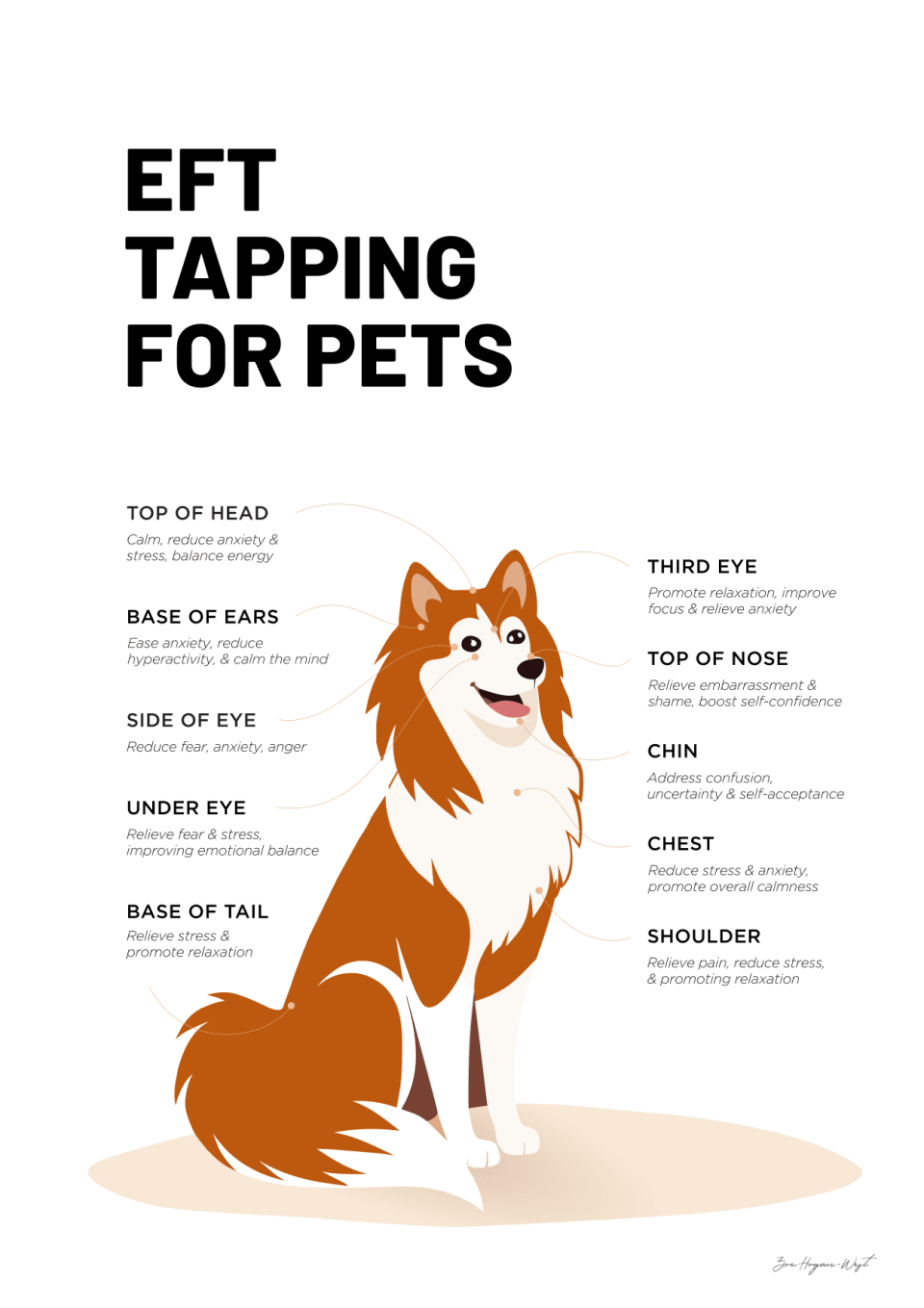
That’s one full round. If the phrases don’t feel natural, change them. Talk to your dog the way you normally would - the tenderness in your voice matters more than the exact words.
What to watch for
After a round or two, pause and watch your dog. Signs of releasing tension include yawning, sighing, shaking off, lying down or just looking softer. If you see a shift, you can stop or do another round with more positive language.
If nothing changes, that’s okay too. Try tapping for your own feelings about the situation first, then come back to tapping for your dog. Sometimes the biggest shift comes from letting go of our own attachment to the outcome.
And if it feels like nothing happened at all? You’ve still spent a few quiet minutes calming your own nervous system, and your dog has been in the presence of that calm. That’s never wasted.
If this sequence helped, you might find it useful before visiting the vet, during storms, or even before a pet photography session - anything where your dog could benefit from you being a bit more grounded.
EFT and pet photography: creating calm before the camera
This is where EFT and my work as a pet photographer overlap in a very practical way.
At Snuggle Studio, every session is built around meeting your dog where they are. I never expect a pet to perform, hold a pose or be something they’re not. The best photos come from real moments of connection, and those only happen when everyone in the room - human and animal - feels at ease.
I’ve worked with dogs who tremble when they meet new people. Dogs who bark at anything unfamiliar. Dogs whose owners apologise before we’ve even started because they’re worried their pet “won’t behave.” And in every one of those sessions, the turning point is the same: when the energy shifts from anxious expectation to quiet patience.
EFT is part of how I get there. I read your dog’s body language. I adjust the pace. I give them space to settle. And I pay close attention to the energy you, as their person, are bringing into the room. If you’re stressed about getting the perfect photo, your dog feels that.
When a dog arrives tense, I’ll suggest the owner takes 30 seconds to breathe and tap before we start. Just a quiet moment in the car or at the door. Nothing dramatic. But it shifts something. The owner’s shoulders drop, their breathing slows, and their dog notices.
That’s what happened with Pippa. She’d tucked herself into her crate and wasn’t ready to meet me. So instead of pushing it, I sat near her and tapped on myself while Rochelle held space nearby. No one forced anything. Pippa came out when she was ready, and once she did, the whole session opened up. We got beautiful, relaxed photos of a dog who, on paper, was “too anxious” for a photoshoot. Trust made the difference - not tricks, not treats, just two nervous systems settling until a third one felt safe enough to follow.
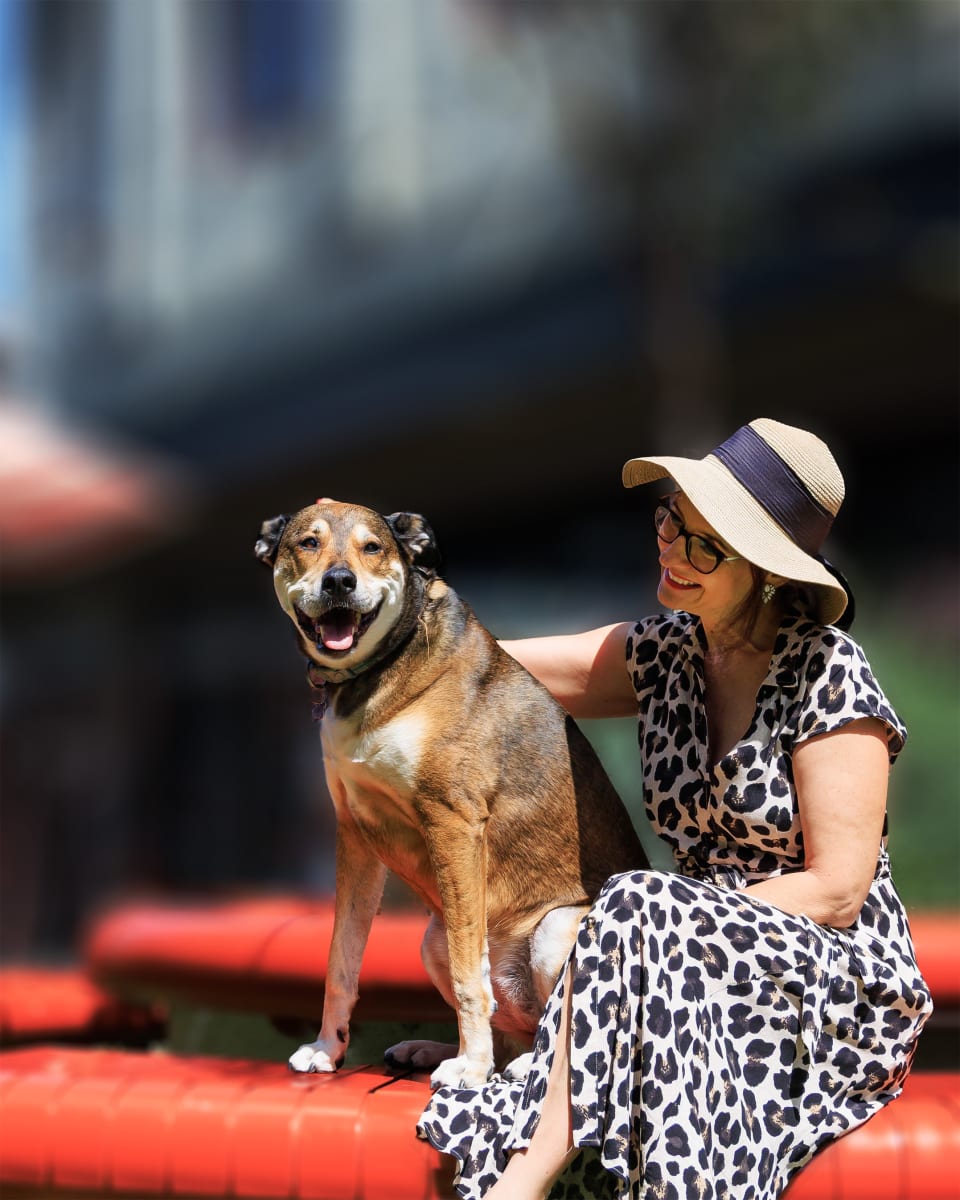
If your dog finds new experiences overwhelming, preparing with a short tapping session at home before you arrive can make a real difference for both of you. Tap for your own nerves about the session. Tap for your dog’s uncertainty about new places. Arrive a bit calmer, a bit more grounded, and let the rest unfold naturally.
This approach is close to my heart through the Misunderstood Dogs sessions, where I work with dogs who carry labels - “reactive,” “aggressive,” or simply “too much.” These dogs deserve to be seen with patience and without judgement. EFT is one more tool that helps create the conditions for that to happen.
Key takeaways
EFT tapping is accessible, free, and takes minutes. You don’t need equipment or training, and with surrogate tapping you don’t even need your dog to cooperate - which is exactly the point for the dogs who need it most.
Start with yourself. If you’re carrying stress about your dog’s behaviour, that’s the most effective place to begin. Your dog is already reading your emotional state. When you shift, they feel it.
And if you’re curious about what this looks like in practice, Pippa is a good example. A big anxious dog hiding in her crate, a worried owner, and a photographer sitting on the floor tapping her own face. No one forced anything. Pippa came out when the room felt safe. Not bad for two minutes of sitting quietly and trusting the process.
Ready to see what calm can look like?
If your dog carries a label like “reactive,” “anxious” or “too much,” they’re exactly the kind of companion I love to work with. The Misunderstood Sessions are designed for dogs who need a bit more patience and a lot less pressure.
Or if you want to chat about what a relaxed session could look like for you and your pet, get in touch. No rush. No expectations. Just a conversation about creating something worth keeping.
More on understanding pet anxiety
- Is Your Pet Stressed? 7 Hidden Signs You’re Missing (Part 1/3)
- The Silent Language of Distress: Recognising and Soothing Your Pet’s Anxiety (Part 2/3)
- Building Lasting Calm: Your Pet’s Journey to Nervous System Resilience (Part 3/3)
- The Truth About 5 Misunderstood Dog Breeds
Recommended reading
- Emotional Freedom Technique for Animals and Their Humans by Joan Ranquet (Amazon)
- EFT for Animals: A Different Therapeutic Relationship (EFT International)
- EFT Can Ease Your Pet’s Emotions (Animal Wellness Magazine)
Frequently Asked Questions
Does EFT tapping actually work for dogs?
There's growing evidence and a significant body of anecdotal support. Animals share similar meridian and neurological systems to humans, and many practitioners report visible behavioural changes after tapping sessions. While peer-reviewed research specifically on animals is still emerging, the underlying principles are well established in human EFT studies.
Can I do EFT tapping on my dog at home?
Yes. Surrogate tapping, where you tap on yourself while focusing on your dog's emotional state, is the easiest and most accessible starting point. No training is required, though reading up on the technique or watching a demonstration can help build confidence.
How long does an EFT session take for a pet?
A single tapping round takes just a few minutes. You can do one round or several, depending on the situation. Watch your dog for signs of relaxation such as yawning, sighing or settling down, and let that guide you.
Is EFT a replacement for veterinary care?
No. EFT is a complementary practice that works alongside traditional veterinary care, training and nutrition. It addresses the emotional side of wellbeing but should never replace professional medical treatment for physical or serious behavioural conditions.
What if my dog doesn't like being touched?
Surrogate tapping is ideal for sensitive dogs because you don't need to touch them at all. You tap on your own body while directing your intention and focus toward your pet. This makes it especially well suited for anxious, reactive or recently rescued dogs.
You might also enjoy...

The Truth About 5 Misunderstood Dog Breeds
Are Staffies, Rottweilers, and German Shepherds really dangerous?

When the Heat Hits: What Our Dogs Need From Us
Practical hot-weather care for dog parents - slowing down routines, frozen enrichment ideas, timing walks wisely, and recognising when dogs are self-regulating.

Building Lasting Calm: Your Pet's Journey to Nervous System Resilience (Part 3/3)
The final part of our pet anxiety series - an 8-week roadmap for building nervous system resilience, covering sound therapy, therapeutic touch, daily regulation rituals, and Melbourne specialist resources.